PurePoint Energy’s Commitment to Our Customers
September 10, 2024
Commercial Solar Installation Companies: Achieving Million-Dollar Projects Without Delays or Cost Overruns
May 6, 2026PurePoint Energy’s Commitment to Our Customers
September 10, 2024
Commercial Solar Installation Companies: Achieving Million-Dollar Projects Without Delays or Cost Overruns
May 6, 2026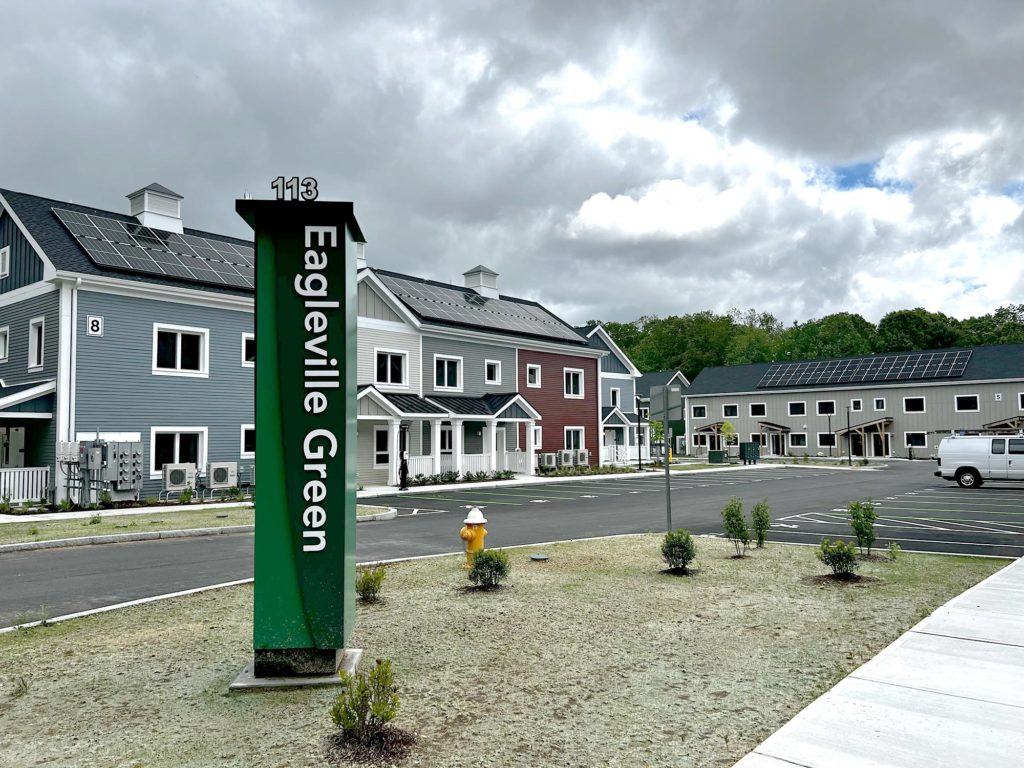
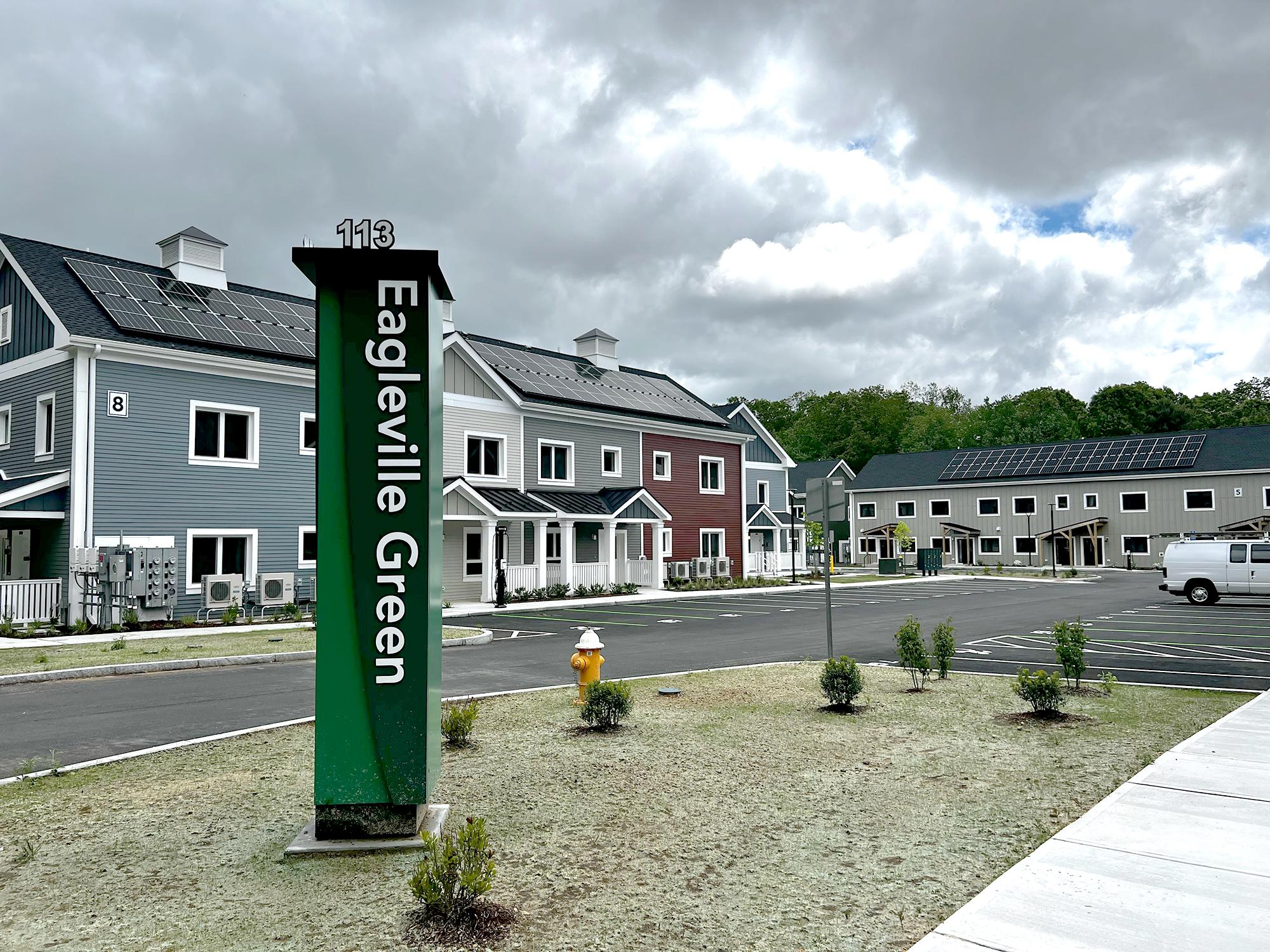
Eagleville Green in Mansfield, CT has earned the 2026 Green Builder Home of the Year Grand Winner designation, and PurePoint Energy’s solar installation was central to achieving that recognition. This 41-unit mixed-income community demonstrates what happens when expert solar design meets Passive House efficiency at scale.
Key Takeaways
- Eagleville Green in Mansfield, CT is the 2026 Green Builder Home of the Year Grand Winner, with PurePoint Energy’s solar installation central to achieving Phius ZERO 2021 certification.
- PurePoint designed and installed a rooftop solar system producing 323,116 kWh annually using high-efficiency 485 W Q.PEAK DUO modules and SolarEdge technology across six buildings.
- Because of Passive House-level efficiency, the development operates at net-zero and regularly exports surplus clean electricity back to the Mansfield municipal grid.
- 34 of 41 units are affordable housing, proving that high-performance solar installations can serve mixed-income communities rather than luxury projects alone.
- PurePoint’s technical expertise and close collaboration with Dorgan Architecture & Planning and Steven Winter Associates were key reasons the project earned the Green Builder Home of the Year honor.
Redefining “Mainstream Green” at Eagleville Green
Eagleville Green stands as a 41-unit mixed-income community in Mansfield, CT that claimed the 2026 Green Builder Media “Home of the Year – Grand Winner” award. The project vision, led by Kathy Dorgan of Dorgan Architecture & Planning, set out to prove that passive house performance, solar panel installation, and compelling design can be affordable and repeatable.
The site features seven multi-family buildings, community spaces, and walkable connections to the University of Connecticut and local transit. This isn’t a one-off showcase project. It targets “mainstream green” through construction methods, solar technologies, and building assemblies that can scale across other Connecticut and New England housing developments.
For those interested in the full story behind this recognition, the Green Builder Media article on Naturally Affordable provides additional context on why this project represents a shift in how we think about sustainable development.
PurePoint Energy: The Solar Installation Partner Behind the Award
PurePoint Energy was selected as the solar company and design-build partner for Eagleville Green based on their proven track record with multi-building, all-electric projects throughout Connecticut. This wasn’t a case of simply adding panels to finished roofs.
The solar scope covered:
- Initial feasibility studies and energy modeling support
- Final array design and equipment selection
- Permitting and interconnection approvals
- Procurement and installation
- Commissioning and ongoing performance support
PurePoint’s role required integrating the solar installation strategy with the passive house envelope, mechanical systems, and Phius ZERO 2021 performance targets. Close coordination with Steven Winter Associates, the sustainability consultant, ensured that solar production and demand assumptions would satisfy Phius energy balance requirements from day one.
By aligning solar installation timelines with Newfield Construction’s schedule, PurePoint kept rooftop work safe, efficient, and on track for the project’s 2025 completion and subsequent 2026 award recognition.
Solar System Design: Turning Passive House Buildings into Power Plants
Six of the seven buildings at Eagleville Green host rooftop solar arrays sized to achieve net-zero or better performance across the entire community. The system transforms these energy efficient buildings into active power generators.
Key System Metrics:
| Specification | Value |
|---|---|
| Total DC Capacity | Approximately 666 kW |
| Annual Production Target | 323,116 kWh |
| Module Type | Q.PEAK DUO 485 W monocrystalline |
| Inverters | SolarEdge with module-level optimizers |
| Buildings Covered | 6 of 7 |
The Q.PEAK DUO modules feature half-cut cell technology with self-cleaning hydrophobic coatings for better snow shedding in New England’s climate. SolarEdge module-level power optimizers enable individual module optimization to counter partial shading from parapets, vents, or nearby trees.
PurePoint optimized tilt angles (30-35° matching Mansfield’s latitude), row spacing to prevent inter-row shading, and stringing configurations for maximum output in Connecticut’s variable weather. The team coordinated conduit routes, roof penetrations, and attachment points with the airtight, super-insulated passive house roof assemblies to protect both performance and durability.

Electrical Architecture and Grid Integration
Connecting six rooftop solar systems into Mansfield’s municipal grid required careful electrical design meeting both code requirements and passive house criteria.
Each building has dedicated AC combiners and meter points, with SolarEdge monitoring providing building-by-building and whole-site performance views. PurePoint designed export-ready systems so surplus energy produced on mild, sunny days flows back to the local grid, supporting the wider Mansfield community.
The team sized conductors, overcurrent protection devices, and equipment clearances to comply with 2023 NEC Article 690 requirements and local utility interconnection standards. Commissioning included string-level verification, insulation resistance checks (greater than 100 MΩ at 1kV), and inverter startup protocols to verify design performance in the field.
Meeting Phius ZERO 2021: Why Solar Installation Quality Matters
Phius ZERO 2021 certification, administered by the Passive House Institute US, requires extremely low energy demand plus on-site renewable generation sufficient for net-zero annual energy on a source basis. The standards align with criteria established by the International Passive House Association while adapting to North American climates.
Because the buildings’ loads were already minimized through passive house strategies—super-insulation, airtightness, and thermal-bridge-free detailing—the solar installation could be right-sized rather than oversized. This approach reduced upfront cost while still achieving net-export capability.
PurePoint used production estimates and load profiles covering heat pumps, ERVs, hot water, and plug loads to confirm the arrays would meet Phius ZERO thresholds. Documentation from PurePoint’s solar design and commissioning was integrated into the Phius submittal package, streamlining verification for the certifier.
The combined effect of the envelope, all-electric systems, and solar means Eagleville Green often operates as a net exporter of clean power—a key reason it was recognized by Green Builder Media as the year’s top project.
Collaborating with the Passive House Design Team
Cross-disciplinary coordination between PurePoint, Dorgan Architecture & Planning, Steven Winter Associates, and Newfield Construction defined how this project came together.
Regular coordination meetings refined:
- Roof geometry and parapet heights (42-48 inches for rail mounting)
- Mechanical equipment locations to avoid shading
- Air-barrier integrity preservation during installation
PurePoint adjusted array layouts to avoid shading from stair towers, mechanical vents, and PV combiner boxes while maintaining balanced string lengths. Constructability reviews with Newfield Construction helped sequence air-sealing, roof membrane installation, and racking attachment to reduce rework and schedule conflicts.
This level of integration serves as a model for future affordable passive house projects that want to maximize the value of their solar installations through early, coordinated planning.
Solar Installation Process: From Concept to Commissioning
The full solar delivery process at Eagleville Green followed a structured path: assessment, design, permitting, installation, and long-term operations support. Although the project is multi-family and complex, the steps mirror what PurePoint follows on smaller residential and community-scale solar installations across CT.
Careful upfront feasibility work avoided design revisions later, helping the project stay on budget and on schedule. Safety planning, worker training, and coordination with other trades were built into every phase.
PurePoint’s approach at Eagleville Green can serve as a template for housing authorities, nonprofits, and municipalities considering similar solar-ready communities throughout New England and beyond.
Site Assessment and Feasibility
PurePoint began by reviewing early massing studies and site plans to estimate solar access, snow loads (30-50 psf per ASCE 7-22 for Mansfield), and roof live-load allowances.
3D modeling and solar path analysis quantified shading from nearby trees, terrain, and adjacent buildings across all seasons. PurePoint worked with the structural engineer to confirm racking attachment methods compatible with the passive house roof assemblies and Connecticut building code.
Preliminary energy models from Steven Winter Associates validated that a roughly 300,000+ kWh/year PV target would be sufficient for Phius ZERO. This phase included early checks on interconnection capacity with the local Mansfield electric utility, reducing risk of later grid constraints.
Detailed Design and Permitting
At this stage, conceptual arrays became detailed, permit-ready construction documents. PurePoint created roof array layouts, one-line electrical diagrams, equipment schedules, and structural attachment details specific to each of the six PV buildings.
Selection of Q.PEAK DUO 485 W modules and SolarEdge inverters was finalized based on performance, reliability, and compatibility with long-term monitoring goals. The Q.PEAK DUO modules offer 30-year product warranties and 87.4% power output at year 25.
PurePoint prepared and submitted electrical and building permit packages to the Town of Mansfield while coordinating responses to plan review comments. Interconnection applications were handled in parallel, securing approvals from the municipal utility to export renewable electricity under net metering tariffs.
Installation, Commissioning, and Handover
PurePoint’s field crews staged racking, modules, and electrical equipment to minimize roof traffic and protect the building envelope. Each roof section was installed in sequence: attachments and flashing first, then rails, then modules, followed by DC wiring, optimizers, and inverter hookups.
Commissioning included:
- Insulation resistance testing
- Inverter configuration and 2023 NEC 690.12 rapid shutdown verification
- Optimizer detection verification (99%+ confirmed)
- Initial performance checks under live conditions
PurePoint provided the ownership team with as-built drawings, warranty documents, and training on the SolarEdge monitoring platform. The team remains engaged post-installation, offering performance tracking and quality assurance to ensure the system continues meeting its 323,116 kWh/year target.
Building Features that Maximize the Value of Solar
Eagleville Green’s building design choices allow the solar installation to deliver far more impact than it would on a conventional project. The “fabric-first” strategy dramatically reduces heating and cooling loads before a single solar panel generates power.
Key Building Features:
- Super-insulation (R-50+ roofs, continuous exterior insulation)
- Airtight envelopes (less than 0.05 cfm50/ft² blower door results)
- Triple-pane windows (U≤0.15 Btu/hr-ft²-°F)
- Thermal-bridge-free detailing throughout
The buildings are fully all-electric, with cold-climate heat pumps (COP 4.0+ at 5°F) for space heating and cooling, plus efficient heat-recovery ventilation systems powered by the rooftop solar arrays. Load-efficient lighting and appliances further reduce energy demand, making it easier for the PV system to achieve net-zero and net-positive performance.
Comfort, Health, and Resilience for Residents
Occupant benefits extend well beyond energy savings. Consistent indoor temperatures, high air quality (PM2.5 levels below 10μg/m³), and low noise levels are fundamental passive house features supported by efficient, solar-powered systems.
The low-load design makes future resilience strategies like battery storage more practical—smaller batteries can keep essential services running during grid interruptions. Because solar offsets a large share of common-area and in-unit electricity use, residents see lower and more predictable energy bills over time.
These performance and comfort benefits were essential to the project’s selection as Green Builder Home of the Year, demonstrating that sustainability and livability go hand in hand.
Affordable Housing, Real Savings: Who Benefits from the Solar Installation?
Eagleville Green is a mixed-income community where 34 of 41 dwellings are affordable units serving households at 30-60% of area median income. Solar is deployed to benefit those residents, not just market-rate tenants.
Lower building energy use paired with solar generation helps keep operating costs in check—estimated savings approach $80,000 annually at current electricity prices. Predictable operating budgets make it easier for affordable housing developers and nonprofit partners to plan long-term maintenance and community programming without worrying about volatile utility costs.
The success at Eagleville Green shows towns and housing agencies that high-performance solar installations can be central to equitable, climate-aligned development. Similar passive house plus solar strategies could be applied to future projects in Connecticut and the broader Northeast to expand access to resilient, low-energy homes for communities that need them most.
Community and Municipal Benefits
The project feeds surplus clean power into the Mansfield municipal grid—an estimated 60,000-100,000 kWh annually—helping to decarbonize local supply and offset approximately 200 tons of carbon dioxide per year. This visible, award-winning solar installation serves as an educational asset, demonstrating passive house and PV technology to nearby residents, UConn students, and policymakers.
The development strengthens Mansfield’s reputation as a forward-looking, sustainability-minded town attractive to families, students, and employers. Long-term performance data from the site will inform future policy discussions around building codes, incentives, and utility programs.
For readers wanting more technical detail about the building performance and environmental benefits, the Steven Winter Associates Eagleville Green project page provides comprehensive information on the energy modeling and certification process.
Why Developers Choose PurePoint for Solar Installation on High-Performance Projects
PurePoint has established itself as a specialist in solar installations for passive house, Phius, and other high-performance, all-electric building projects throughout the Northeast. The company brings experience with multi-building campuses, affordable housing, schools, and community facilities requiring careful integration of PV with complex envelopes and mechanical systems.
PurePoint’s End-to-End Services Include:
- Feasibility analysis and energy modeling support
- System design optimized for building performance targets
- Permitting and utility interconnection
- Installation by trained crews
- Commissioning and performance verification
- Long-term monitoring and service
Eagleville Green’s Green Builder Home of the Year recognition confirms that PurePoint’s approach can meet the most demanding energy and sustainability benchmarks. Happy customers result from this level of coordination and technical expertise.
For architects, developers, housing authorities, and municipalities considering similar projects, engaging PurePoint early in project planning helps maximize the environmental impact and value of solar installations while keeping costs controlled and schedules on track.
Frequently Asked Questions
These questions address common topics not fully covered in the main article, focused on solar installation and high-performance communities. Answers are grounded in the Eagleville Green experience and intended for developers, architects, housing authorities, and sustainability professionals considering similar projects.
How large is the solar installation at Eagleville Green, and how much energy does it produce?
The rooftop solar arrays span six buildings and use high-efficiency 485 W Q.PEAK DUO modules, totaling approximately 666 kW DC. The system is modeled to produce about 323,116 kWh of renewable energy per year under typical Mansfield, CT weather conditions. Because the buildings are so efficient, this production offsets annual site energy consumption and exports surplus power back to the local grid. Actual year-one performance will be tracked through the SolarEdge monitoring platform to verify these estimates.
What makes this solar installation different from a typical residential rooftop system?
Unlike a single-family system that might take 1-3 days to install solar panels, Eagleville Green’s solar installation serves multiple multi-family buildings, common spaces, and an entire community’s energy strategy. Design decisions were tightly coordinated with passive house envelope details, mechanical systems, and Phius ZERO certification requirements—coordination not typical on standard houses. The electrical architecture satisfies municipal utility export rules, multi-meter configurations, and long-term monitoring requirements for owners and performance certifiers. The project’s scale and integration, plus its role in securing the 2026 Green Builder Home of the Year award, sets it apart from typical residential solar installations.
Can affordable housing projects realistically achieve Passive House and net-zero with solar?
Eagleville Green demonstrates this is absolutely possible: 34 of its 41 units are affordable, and the project achieved Phius ZERO 2021 certification with rooftop solar. The key is a “fabric-first” approach that reduces loads before adding PV, allowing smaller, more cost-effective solar installations to close the remaining energy gap. Careful coordination among the architect, sustainability consultant, contractor, and solar installer controls costs and avoids late-stage redesign. Funding programs, green building incentives, and long-term operational savings further support the economics of this approach.
How does PurePoint ensure roof integrity and airtightness on Passive House projects?
PurePoint works closely with design and construction teams to pre-plan all roof penetrations, attachment points, and conduit routes before site work begins. Attachment details use tested, fully flashed penetrations compatible with the roofing system and air-barrier assembly, minimizing risk of leaks or thermal bridging. Installation crews receive project-specific training on handling membranes, insulation, and parapets to preserve airtightness and insulation continuity. Follow-up inspections and coordination with blower-door testing confirm that the solar installation did not compromise passive house performance—a key element of quality assurance on these projects.
What should developers do early in design if they want a similar solar installation on their project?
Engage a qualified solar installer like PurePoint during schematic design, not after construction documents are complete. This allows roof forms, mechanical layouts, and electrical rooms to be optimized for PV from the start. Set clear energy and certification targets (such as Phius ZERO or net-zero site energy) and use early energy modeling to define a realistic solar production goal. Review local utility interconnection requirements and incentive programs early to understand export limits, metering options, and potential funding support. Aligning procurement, permitting, and construction schedules with the solar scope—as was done at Eagleville Green—reduces change orders and keeps the project on time and on budget.