Solar Installation at Eagleville Green: How PurePoint Delivered an Award-Winning Net-Positive Community
April 1, 2026
Commercial PV Panel Installation: Expert Solar PV Installers for Businesses & Nonprofits in CT, RI, MA, & Westchester
July 29, 2026Solar Installation at Eagleville Green: How PurePoint Delivered an Award-Winning Net-Positive Community
April 1, 2026
Commercial PV Panel Installation: Expert Solar PV Installers for Businesses & Nonprofits in CT, RI, MA, & Westchester
July 29, 2026
If you’re evaluating a large-scale solar installation for your Connecticut, Rhode Island, or Westchester County commercial property, you already know the stakes. Projects of this magnitude—500 kW to multi-megawatt systems—require precision engineering, airtight incentive coordination, and contractors who understand that missed timelines translate directly to lost revenue.
Most commercial solar installers overpromise and underdeliver. To ensure transparency and make the best decision based on equipment quality, warranties, and estimated costs, it’s wise to compare proposals from at least three commercial solar installation companies. Superficial site assessments lead to scope creep. Permitting delays cascade into interconnection bottlenecks. Incentive applications miss critical deadlines. What started as a straightforward path to energy independence becomes a frustrating drain on your time and capital.
PurePoint Energy was built to eliminate that frustration. As a commercial solar energy installation company and turnkey EPC provider with deep roots in CT, RI, and Westchester County, we specialize in million-dollar commercial solar projects for commercial property owners, agricultural operations, and nonprofit organizations. PurePoint is fully licensed and insured, providing peace of mind and mitigating liability for our clients. Our approach delivers budget certainty, timeline adherence, and the kind of local expertise that transforms complex solar projects into measurable cost savings.
Why PurePoint Energy’s EPC Services Deliver Results
Here’s what distinguishes our commercial solar expertise from typical contractors competing for your business:
- Complete Turnkey EPC Capability – We handle every phase from system design through commissioning and post-installation support, eliminating the coordination headaches of managing multiple vendors across your solar installation
- Grant Navigation Expertise – Our team maximizes your incentive stack, including federal tax credit programs, state REF/REG production payments, NRES contracts, and C-PACE financing options specific to Connecticut and Rhode Island, aligning with our broader commercial solar installation services
- Custom System Engineering – Rather than cookie-cutter designs, we engineer commercial solar panels configurations optimized for your specific energy usage patterns, roof conditions, and export/consumption ratios
- 25-Year Lifecycle Support – Warranties mean nothing without responsive service; our maintenance programs protect your solar assets through their entire productive lifespan
- Local Market Intelligence – Operating in CT, RI, and Westchester means we know your utility rate structures, municipal permitting requirements, and interconnection timelines—reducing unknowns that derail other projects
- Professional Installers help navigate complex regulations, securing necessary permits and ensuring compliance with local codes during the installation process.
- NABCEP certification is a key credential for reputable commercial solar installers, indicating technical proficiency in solar energy systems.
- Extensive Warranties from Professional solar installation often include equipment and workmanship, ensuring long-term reliability.
- Maintaining Manufacturer Warranties on solar equipment is often contingent on professional installation by certified experts.
Instead of forcing you to manage disjointed contractors and chase incentive paperwork, we deliver a streamlined path to renewable energy adoption with predictable outcomes.
How Our Commercial Solar Installation Process Works
Getting results from a million-dollar solar energy system doesn’t require complexity. Our entire process is designed to move efficiently from initial assessment to energy generation, addressing potential challenges before they become expensive surprises. Other factors, such as component selection and installation procedures, are also carefully considered to ensure a successful solar system setup.
Step 1: Comprehensive Site Assessment and System Design
Every enterprise project begins with a detailed energy consumption analysis and structural evaluation. We map your electricity usage patterns, demand charge profiles, and seasonal load variations. Our engineers conduct shading studies, assess roof or ground-mounted system options, and evaluate structural reinforcement requirements for properties across the areas we serve. Solar panels generate direct current (DC) electricity, which is then converted to alternating current (AC) by an inverter—this device converts the DC power into AC, making the energy usable for standard building applications.
This rigorous front-end work identifies potential challenges before they become expensive surprises. For agricultural businesses, we analyze irrigation pump schedules and processing facility demands. For commercial property installations, we optimize system size against your electricity bills and export potential under current net metering rules. For new manufacturing facilities, rooftop solar is a critical component of your energy strategy, utilizing the flat or sloped surfaces of commercial buildings to generate electricity without requiring additional land.
The result: a custom-engineered solar system design with accurate production modeling and realistic cost projections.
Step 2: Permits, Incentives, and Project Management
Navigating permitting requirements and incentive programs in Connecticut, Rhode Island, and New York simultaneously is challenging for most contractors. Our project managers maintain active relationships with municipal authorities, utilities like Eversource, National Grid, and ConEd, and state energy offices.
We coordinate your investment tax credit documentation, manage REG program enrollment in Rhode Island, submit NRES applications in Connecticut, and secure NY-Sun megawatt block incentives for Westchester projects, and, where appropriate, integrate commercial solar energy storage solutions to further enhance project economics. For the federal tax credit—currently 30% for projects beginning construction by July 4, 2026—we ensure your timeline protects eligibility.
Critical deadlines are tracked. Interconnection studies are initiated early. Permitting applications move in parallel with procurement. This coordinated approach prevents the cascading delays that plague poorly managed solar projects.
Step 3: Installation, Commissioning, and Ongoing Support
Construction proceeds with high-efficiency panels from manufacturers such as SunPower and REC—modules that deliver 22-24% rated efficiency with 25-year performance warranties. String inverters or module-level power electronics are selected based on your site’s shading conditions and structural configuration.
Our installation teams understand local structural codes, snow load requirements, and utility grid connection protocols. System commissioning includes comprehensive testing, coordination of utility inspections, warranty activation, and verification that your solar power production matches engineering projections. The inverter converts the direct current (DC) produced by the solar panels into alternating current (AC), which is then supplied to your building’s electrical panel and can be exported to the electric grid.
Post-installation support includes O&M contracts, performance monitoring, and rapid response service—ensuring your commercial solar system delivers the estimated savings and energy production you expect for decades. Battery energy storage systems can ensure continuous operation during outages and help reduce peak charges, making them a valuable addition to commercial solar installations.
What Makes PurePoint Energy Different from Other Commercial Solar Companies
Most national commercial solar installer firms treat Northeast projects as one-offs, lacking the local relationships that accelerate approvals and prevent costly delays.
- Local Focus vs. National Scale – We operate exclusively in Connecticut, Rhode Island, and Westchester County. This geographic concentration means deeper utility relationships, faster permitting, and fewer surprises from unfamiliar jurisdictions
- Specialized Expertise – Agricultural operations and nonprofit organizations have unique requirements. We understand how to structure power purchase agreement options for tax-exempt organizations and optimize solar energy systems around seasonal irrigation loads. Learn more about our commercial solar installation approach and the team behind PurePoint Energy.
- Full Lifecycle Partnership – From initial site assessment through year 25 of operation, we remain accountable for your system’s performance. Competitors disappear after commissioning; we protect your investment
- Measurable Project Performance – Our project completion rates and budget adherence exceed industry averages because we price honestly, schedule conservatively, and execute relentlessly
If national installers offer complexity, we offer clarity. If others require you to manage the details, we handle the entire process.
Proof Our Commercial Solar Installations Deliver Value
Results speak louder than marketing claims.
“PurePoint delivered our 750 kW rooftop installation two weeks ahead of schedule and 4% under budget. The incentive coordination alone saved us nearly $180,000 in potential missed deadlines.” — Facilities Director, Connecticut Manufacturing Facility
“As a nonprofit, we needed a partner who understood our unique financing constraints. PurePoint structured a PPA that captured the investment tax credit through a third-party owner while maximizing our operating expense savings.” — Executive Director, Rhode Island Nonprofit Organization
Our portfolio includes:
- 3.2-year average payback periods on Connecticut commercial installations after incentive stacking, consistent with the benefits outlined in our commercial solar FAQ
- 15-25% project IRR on properly sized systems with optimized export and consumption ratios
- Zero interconnection deadline misses across our recent large-scale solar arrays in RI and CT
Data from our installations confirms that enterprise solar projects deliver when executed with precision engineering and proactive project management.
Who Benefits Most from PurePoint Energy’s Commercial Solar Services
Our commercial solar solutions are designed for:
- Commercial Property Owners with energy costs exceeding $50,000 annually who want 20+ year utility bill reductions and protection against electricity rate escalation
- Agricultural Businesses seeking to offset irrigation, cold storage, and processing energy expenses while capturing enhanced incentives for renewable energy source adoption
- Nonprofit Organizations pursuing sustainability targets while maximizing grant funding, REF grants, and production-based incentive programs without managing complex tax credit structures
- Business Owners in Connecticut, Rhode Island, and Westchester County who want to lower utility bills and operating costs—solar energy savings can directly benefit the business owner by freeing up capital for reinvestment into the business, supporting growth and financial stability
If you want to reduce reliance on volatile utility rates while advancing your sustainability goals, our solar installation services were built for your company.
Investment Levels and Financing Options
Choose the project scale that matches your energy needs and financial objectives.
Commercial Systems ($1M – $3M)
Ideal for businesses with energy requirements of 500 kW to 1 MW.
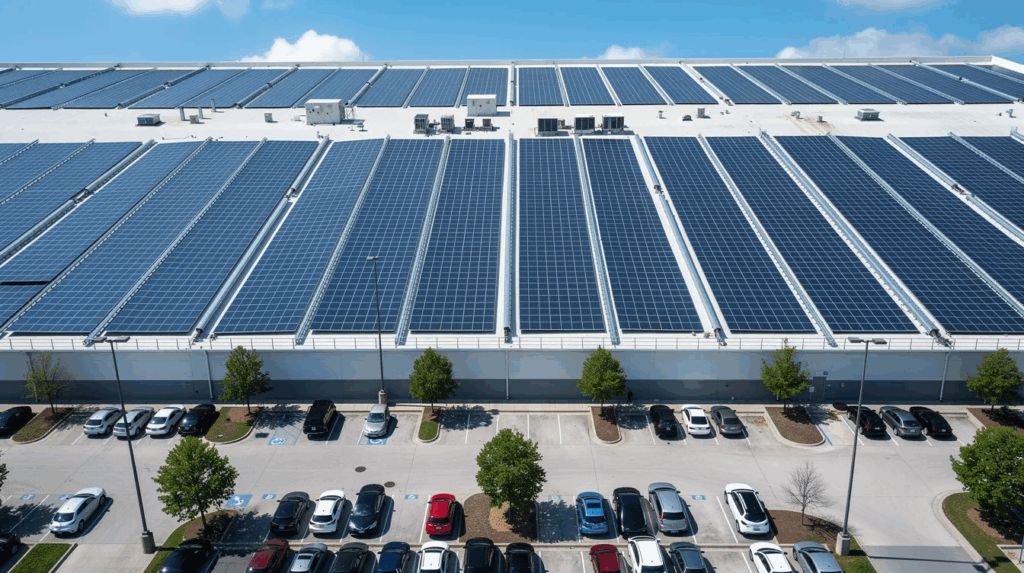
- System Size: 500 kW – 1 MW rooftop, ground-mounted, or solar carports configurations. Solar panel installation options include rooftop, ground-mounted, and carport systems to fit your property’s needs.
- Energy Production: 650,000 – 1,300,000 kWh annually
- ROI Projections: 3-5 year payback with full incentive stack
- Incentives: 30% federal investment tax credit, MACRS depreciation, state production payments, sales and property tax exemptions
Carport solar installations provide shade for vehicles while generating electricity, effectively using parking lot space for renewable energy.
Financing options include direct ownership, C-PACE, and competitive PPA structures.
Large Commercial & Agricultural ($3M – $8M)
Designed for multi-building facilities and agricultural operations with substantial electricity usage.
- System Size: 1 MW – 3 MW, with optional integration of energy storage systems. Ground-mounted solar arrays are installed on open land and can be oriented to maximize sunlight exposure, often resulting in higher energy production than rooftop systems.
- Energy Production: 1,300,000 – 4,000,000 kWh annually from commercial solar energy installations
- Advanced Features: Battery storage for demand charge reduction, peak shaving, and clean energy backup. Energy storage solutions allow businesses to store excess solar energy for use during peak demand hours, leading to significant cost savings. Integrating energy storage with solar systems can enhance energy independence and enable businesses to sell surplus energy back to the grid.
- Enhanced Incentives: ConnectedSolutions demand response payments, storage adders, and agricultural-specific programs
Specialized engineering addresses seasonal load profiles and large-scale solar arrays requirements.
Commercial Solar Benefits
Investing in solar energy allows companies to demonstrate their commitment to sustainability and reduce the environmental impact of their operations, thereby enhancing their reputation among employees, customers, and investors.
A well-designed commercial solar system can provide long-term clean energy, reduce operating expenses, help businesses save money by lowering their electric bill and ongoing utility bills, and support corporate sustainability goals by lowering a company’s overall carbon footprint.
Equipment quality is crucial; choosing the right solar panel is essential for long-term performance and financial returns—using premium components from Tier-1 manufacturers can lead to better long-term performance and lower maintenance needs.
By generating their own electricity, businesses can hedge against fluctuating energy prices, effectively fixing their electricity costs for the lifespan of the solar system, which can last 25 years or more.
Enterprise & Portfolio Projects ($8M+)
Custom solutions for multi-site installations and portfolio-wide renewable energy deployment.
- Scope: Multi-megawatt installations across multiple commercial property locations
- Dedicated Resources: Assigned project managers, priority support, and executive-level reporting
- Custom Financing: Structured power purchase agreement options, direct ownership, and hybrid arrangements
- Total System Cost Optimization: Volume procurement, coordinated permitting, and centralized O&M
Tax Incentives for Your Commercial Solar Installation
Businesses can qualify for a federal investment tax credit equal to 30% of the total system cost for commercial solar installations.
Accelerated depreciation allows businesses to recover a significant portion of their solar investment by deducting much of the system’s value over the first several years, enhancing the project’s return on investment.
In addition to the federal tax credit, businesses in designated energy communities may qualify for an additional 10% tax credit.
Enterprise clients receive quarterly performance reviews, proactive system optimization, and support from a team whose about us story is rooted in long-term partnership.
Frequently Asked Questions
How long does a million-dollar commercial solar installation typically take?
Projects typically require 6-12 months from contract signing to commissioning. Timeline variables include interconnection queue position (which can add 6-24 months for utility-scale systems), permitting complexity, and equipment procurement lead times. Our project management approach runs workstreams in parallel to compress timelines.
What permits and approvals are required in Connecticut and Rhode Island?
Requirements vary by municipality and system size but typically include building permits, electrical permits, zoning approvals, and utility interconnection agreements. Connecticut’s NRES program and Rhode Island’s REG program require separate application processes. We handle all permitting requirements as part of our EPC service.
How do federal tax credits and state incentives reduce project costs?
The investment tax credit currently provides 30% of the total system cost as a direct reduction in tax liability for projects beginning construction by July 4, 2026. State incentives—including Rhode Island’s REG payments (~$0.27/kWh for 15-20 years), Connecticut’s NRES contracts, and sales/property tax exemptions—can reduce net project costs by 40-50%. A tax professional should confirm your specific eligibility.
What warranties and maintenance support come with commercial installations?
Premium panels include 25-year performance warranties guaranteeing production levels. Inverters typically carry 10-25 year warranties. Our workmanship warranty covers installation quality, and O&M contracts provide ongoing monitoring, preventive maintenance, and rapid response service throughout your system’s lifecycle.
How does net metering work for large commercial solar systems?
Net metering allows surplus energy exported to the local power grid to offset future electricity bills, helping to lower your electric bill by crediting you for excess energy your system generates. Connecticut permits virtual net metering up to 2 MW. Rhode Island’s current policy provides approximately 80% of the retail rate for exported energy (changed from 1:1 in April 2023). System design optimizes the balance between onsite consumption and grid export based on current rate structures.
What financing options are available for million-dollar solar investments?
Options include direct ownership (capturing full tax credit and depreciation benefits), third-party ownership via purchase agreements or lease structures, and C-PACE financing that ties payments to property tax assessments. The optimal structure depends on your tax position, capital availability, and risk tolerance. We provide detailed financial modeling for each scenario.
Start Your Commercial Solar Project Today
If you’re ready to stop struggling with unreliable contractors and start achieving predictable returns from commercial solar power, the next step is straightforward.
Schedule a comprehensive site assessment with our engineering team. We’ll analyze your energy usage, evaluate your property, and deliver a detailed ROI analysis with custom system design options, or contact our Connecticut and Westchester solar team directly to discuss your project.
Within 30 days, you’ll have the information enterprise decision-makers need: accurate production projections, complete incentive analysis, realistic timelines, and fixed-price proposals.
[Schedule Your Site Assessment] [Request a Custom Proposal]
PurePoint Energy has delivered successful commercial solar installations across Connecticut, Rhode Island, and Westchester County for business owners seeking to save money, achieve measurable cost savings, and reinvest those savings into business growth.
No inflated promises. No hidden costs. Just a sustainable future powered by clean electricity and measurable cost savings.